

bits and Biomes
Investor Interview Series with Darwin Ventures:
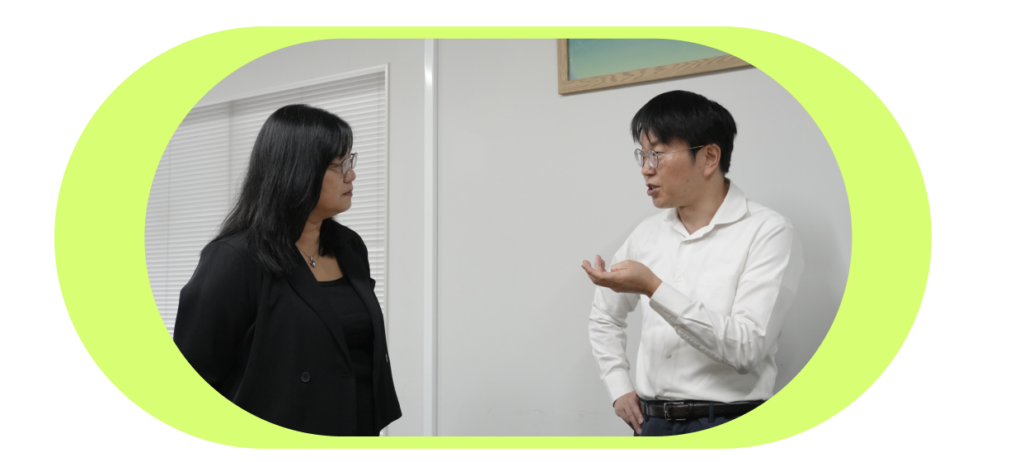
bitBiome sat down with Emily Wu, Partner, from Darwin Ventures to discuss their investment strategy and why bitBiome stands out.
Q. Can you provide an overview of your firm and investment focus?
Founded in 2009, Darwin is a venture capital firm with over 15 years of experience in the industry. We have managed nine different funds, ranging from angel funds to secondary market funds. One of our most unique strengths is our role as a strategic bridge between Taiwan and Japan. We recently launched the Darwin Global I Fund (Fund IX), a US$60 million fund dedicated to creating synergy between Taiwan and Japan. Our goal is to combine Japan’s world-class basic science and research with Taiwan’s legendary manufacturing and integration capabilities.
As our investment focus, we maintain a 50/50 balance between Software & Digital Economy and Deep Tech. While we cover all stages, we are particularly active in the early stages, with nearly 60% of our portfolio in the seed, pre-series A, and series A stages. Historically, 81% of our investments have been in Taiwan, but we are rapidly expanding our footprint in Japan and the US. We will allocate 30% of the new fund to invest in Japanese deals.
Q. What themes or technologies are you most excited about?
We focus our capital on four high-impact sectors:
Digital Economy (50%): AI, Digital Transformation (DX), SaaS, and Cybersecurity.
Biomedical (20%): life science, digital health, and advanced medical devices.
Materials & Equipment (20%): semiconductors, EV components, and green energy.
ICT & Robotics (10%): Including physical AI, telecommunication, aerospace, and defense technologies.
Q. What are some characteristics of your most successful portfolio companies?
The quality of the team, the ability to solve real market pain points, and a focus on global scalability. If you have the right people, you’re halfway to success. Successful teams demonstrate the ability to pivot during crises. For example, during the pandemic, KKDay shifted to selling domestic vouchers, Inline moved from restaurant bookings to food delivery, and Jubo Health collaborated with hotels for daycare services. Darwin looks for founders with strong execution capabilities, high psychological resilience, sharp business intuition, and a commitment to integrity.
We also look for a “Day 1” Global Strategy and Scalability: Facing the global market and a fast-growing market. For example, Winway is the queen of Taiwan’s stock market price, with 70% of its revenue coming from overseas customers. It targets a high speed, high current, and high frequency test interface. When we invested in 2014, its revenue was ~28 million USD per year, and now it achieves ~32 million USD per month.
We also look for companies with a clear exit path.
Q. How do you evaluate Japanese deep-tech startups overall?
Darwin evaluates Japanese deep-tech startups by focusing on the synergy between Japan’s excellence in basic science and Taiwan’s industrial manufacturing capabilities. We evaluate if a startup’s technology can be integrated into Taiwan’s supply chains, especially in semiconductors, biomedical, and advanced materials.
We value team quality, technical moats, and clear go-to-market paths through international partnerships.
We also actively search for academic spin-offs from top-tier institutions like The University of Tokyo, Tohoku University, Waseda University and so on. We look for “unique, patented” technology, such as bitBiome’s single-cell genome sequencing or Ball Wave’s advanced chemical sensing technology.
Q. What types of companies do you actively avoid?
We avoid investing in companies that have the following:
Unfamiliar markets: We do not invest in markets or industries where we lack expertise. In unfamiliar markets, we cannot perform good due diligence or help the team through our existing networks.
Low barrier to entry: We avoid companies that don’t have innovative technology or services with high entry barriers.
“Pure” Research Projects: We distinguish between Knowledge Value (novelty and proof) and Market Value (scalability, replicability, and monetization). We avoid projects that are “just a paper” and lack a clear path to being adopted by the world.
Vague exit strategies: If a team cannot provide a clear Go-to-Market strategy or a foreseeable exit (IPO, M&A, or trade sale), we will pass.
Weak business logic: We avoid startups that focus too much on technology while failing to explain how they will make money or why customers should pay for their solution.
Q. Why did bitBiome not fall into that category?
Although bitBiome is an academic spin-off from Waseda University, it avoided the “pure research” trap by demonstrating strong commercial potential and strategic alignment with Darwin’s focus on Biomedical and AI. bitBiome did not fall into that category for several reasons:
High entry barrier: It has a unique, patented single-cell whole-genome sequencing platform that offers a clear competitive advantage in the market.
Proven commercial impact: Unlike pure research projects, bitBiome has successfully turned biology into high-value, scalable products, achieving a 10x improvement in time-to-market for its clients.
Existing revenue and global reach: bitBiome has already demonstrated market traction from major global markets, including Japan, the US, and Asia.
Clear problem-solving capability: bitBiome uses “AI Bio-Design” to turn “impossible” molecules into profitable products, such as PET-degrading enzymes and renewable chemicals made by agricultural waste.
Strategic Synergy: bitBiome fits Darwin’s specific “Taiwan-Japan” investment thesis. We want to combine Japanese basic science excellence with commercialization and industrial scaling.
Q. What made bitBiome different from other companies you were looking at?
bitBiome is different from other biotech companies because it combines advanced single-cell sequencing, a massive proprietary database, and a clear focus on industrial biomanufacturing.
Your sequencing technology (bit-MAP®) is much more efficient compared to traditional methods and is a game changer for microbial discovery.
Using your proprietary sequencing technology, you have built a huge database (bit-GEM), with over 3 billion genomic sequences. This gives bitBiome access to new proteins and enzymes that competitors simply can’t find in public databases.
bitBiome also has a fully integrated “data-to-product” workflow. It starts with discovery, organizes the data, and then engineers solutions. This end-to-end capability is rare. Your engineering platform is also much faster and cheaper than traditional methods.
bitBiome overall benefits from better data, better tools, and a more efficient way to turn discoveries into real products
Q. At what point did we move from ‘interesting’ to a ‘serious investment candidate’?
bitBiome has unique technology, but originally, we didn’t know how bitBiome could make money and we weren’t clear about bitBiome’s go-to-market strategy. The most important of all, we didn’t know how to exit if we invested in bitBiome. From our understanding, bitBiome had many service projects going on which was not bad. It proved that bitBiome’s technology is working and useful. However, only non-recurring revenue as a source of revenue is not sustainable. Until at the end of 2024, bitBiome had their first product, an enzyme screening kit, launched with Twist Bioscience. While they started as a service company (doing sequencing for others), they’ve successfully pivoted toward a revenue-generating product model.
Q: Many companies today claim to be “AI for biology”. What convinced you that bitBiome’s AI opportunity is fundamentally different?
Two things: A huge and continued growing database, and two, wet lab capability.
We saw many “AI for biology” companies, but they only have dry labs and rely on 3rd party’s wet labs for further verification. That does not work. For example, if you want to make a delicious dish (French cuisine, Japanese cuisine), you must have your own kitchen. If you only have a brilliant idea of a recipe but don’t have your own kitchen, you have to ask a friend to make it for you. How can you make a delicious meal? If you have your own kitchen, you can taste and make quick adjustments every time. The most beautiful part is that you have a huge amount of ingredients in your kitchen that nobody has, your 3 billion gene database.

Q. What was your first reaction to the company and technology?
We were very impressed by how quickly you can develop a new enzyme by using your solutions. For example, engineering a functional plastic degradation enzyme, instead of taking 7 years took only a few months! I particularly have a lot of personal feelings on this. I used to feel guilty about the plastic products because they last forever and are very harmful for the environment. However, I also appreciate plastic products because my father produced and sold them to support my family. It’s meaningful to see a solution that can help address the issue.
Q. How do you evaluate platform companies like bitBiome vs a single-product company?
A platform company provides a lot of possibilities including lower risks to investors. Platforms apply a core technology across diverse sectors (pharma, food, chemicals). If there is only a single product and it fails, the whole company fails. If you can have a different revenue mix, the success depends on generating steady service revenue (sequencing/engineering) to extend the runway while building high-value, proprietary products.
Additionally bitBiome benefits heavily from a proprietary moat: Value is driven by exclusive data assets. For example, bitBiome’s bit-GEM database (3 billion+ sequences) creates a never-seen-before “treasure island” advantage over public data.
Q: Why do you think having both computational and wet-lab capabilities matters? Couldn’t an AI company simply partner for the experimental side?
I believe there are a lot of secret sources accumulated if you have your own web lab. It also builds up a higher entry barrier. Frankly speaking, AI just decreases a huge amount of trial-and-error effort. But you still need to try! Otherwise, you don’t know if the outcomes fit what you want. Your team can also accumulate that know-how during trial-and-error in the wet lab and become the future nutrients for success.
Q. When you think back to your decision, what really tipped you toward investing in bitBiome?
For our 1st investment it was your ability to expand business outside of Japan and having a product launched in the USA.
For our 2nd investment, what impressed us most was your significant revenue growth and the potential to work with the Taiwan semiconductor industry and our other portfolio companies.
Q. How do you think about data scale and uniqueness in this space, and where does bitBiome stand out?
The data scale can make impossible possible. If you want to develop a novel enzyme or protein, a huge number of sequences in your database can help!
Q: Why is scale of data so important in this field? Is this simply a matter of having more genomes than competitors or do you think quality of data is more important?
Both are important. More genomes give you more flexibility to find a novel enzyme or protein. Quality of data is also important. Because bitBiome sequences single cells, longer and more accurate gene sequences can be captured, which are very important for identifying complex functions. Going back to the example of cooking, if you want the dish to be sweeter, you need to just grab one jar with a tag of sugar. But if it turns out that it’s actually salt inside the jar, then that will be a disaster! So, you not only need a lot of “jars”, but they need to be appropriately labeled as well.
Q: Many companies understand that data is valuable. Why do you believe bitBiome has an advantage in acquiring data itself?
While many companies recognize data’s value, bitBiome holds a significant competitive advantage in acquiring that data due to its unique sequencing technology. bitBiome has superior and efficient data capture capability. Adding a billion more data sets each year is an amazing achievement.
Q. What gives you confidence that bitBiome can build a lasting advantage, and how hard would it be for someone else to catch up?
Lasting advantages:
Unique and Patented Technology (bit-MAP®): Unlike traditional methods, bitBiome utilizes a proprietary microbial single-cell whole-genome sequencing platform. This patented technology allows for the fast and accurate acquisition of gene coding sequences that were previously difficult to capture.
Massive Proprietary Database (bit-GEM): You have built what is described as a “Microbial Genome Encyclopedia,” containing over 3 billion diverse genomic sequences. The scale and diversity of this library act as a significant data moat. It’s not easy for a competitor to achieve so.
Superior AI prediction (SENS-AI): bitBiome leverages generative AI for biology, with prototypes showing a >15x prediction capability. By combining AI-driven protein engineering with your massive database, you can discover and design functional enzymes and proteins with far greater precision than traditional lab-based research.
Why It Is Hard to Catch Up
bitBiome’s patented technology creates better data, their massive database powers better AI, and their AI delivers faster commercial results, making it increasingly difficult to catch up.
Time-to-Market: bitBiome aims to offer a 10x faster time-to-market for commercial bio-production. In the deep-tech and biomedical sectors, where development cycles are typically long and capital-intensive, this 10X faster speed lets bitBiome secure market share while others are still in the R&D phase.
Commercial Validation: Unlike “pure” academic projects, bitBiome has already transitioned into a commercial platform with over 4 million USD in revenue in 2025 across Japan, the US, and Asia.
High Technical Entry Barriers: It takes multiple years for competitors to replicate the combination of single-cell sequencing hardware, the multi-billion sequence database, and the refined AI algorithms.
Q. Were there any risks you had to get comfortable with along the way? What helped you get there?
Management Instability and Leadership Turnover: For early-stage investments, the team is the most critical factor. bitBiome went through multiple CEOs since its spin-off in 2018. Such frequent turnover in a startup is usually a major red flag for corporate governance. However, after talking with your lead investor, UTEC, I learned that these changes were strategic and stage appropriate. UTEC was deeply involved in these transitions to ensure the company moved from academic research to commercial business development. The arrival of Yuji Suzuki, who brought a background from McKinsey and strategic corporate BD, signaled that the company was finally ready to transition from a “science project” to a market-oriented leader.
From laboratory research to a commercially viable business: In its first three years, management struggled to define a clear business application for their sequencing technology. VCs often fear “technology in search of a problem,” and bitBiome spent years refining tools without a clear product. The company executed a successful pivot toward industrial biomanufacturing such as fragrance, food nutrition, PET-degrading enzymes and renewable chemicals like acrylic acid.
Q. From your perspective, what makes this team different from others you’ve looked at? For example, what kind of team culture and members’ mindset make you most excited?
bitBiome had multiple CEO transitions to ensure that the company moved from academic research to focus on business development and industrial applications. CEO Yuji Suzuki brings a rare combination of McKinsey strategic consulting and international diplomacy experience. He is a “market-oriented person” rather than just a scientist, which is critical for scaling a platform company.
Additionally, bitBiome has a global first culture. You were able to attract overseas top talent who have more than 20 years of experience in data science and enzyme engineering.
Q. Why does this feel like the right moment for bitBiome, and how does it fit into where the industry is heading?
This is a pivotal moment for bitBiome because the company sits at the intersection of three major industry shifts: the transition to biomanufacturing, the explosion of generative AI, and a global focus on supply chain resilience and sustainability.
“Data bottleneck” for AI: bitBiome’s bit-MAP platform is the only single-cell sequencing technology that achieves assembly ratios of over 80%, making the data more complete and accurate. bitBiome’s 3 billion sequences allow them to find novel proteins such as enzymes that eat plastic or capture carbon.
Environmental, social, and governance trends: The world wants to decrease reliance on petrochemicals and toward sustainable, bio-oriented production. (especially in light of recent geopolitical events and oil crises). bitBiome is actively involved in high-impact projects like carbon recycling and plastic waste mitigation (e.g., their PET-degrading enzymes achieved best-in-class efficacy in just 8 weeks).

Q. What excites you the most about bitBiome’s long-term potential?
The ability to make a better world, benefit human beings and the environment through bioproduction of renewable chemicals like acrylic acid, PET-degrading enzymes, developing new drugs, waste treatment, and so on.
Q: Why do you think microbial biology may be a more attractive AI opportunity than human biology over the next decade?
Microbial biology has a wide range of industrial applications. Microbes can be used to produce pharmaceuticals, food, clean energy, new materials, and even solve environmental problems. Unlike human biology, there is no need to spend a lot of money on clinical trials or get FDA approval. Return on investment is achieved much faster.
Q. Where do you see bitBiome in 5-10 years?
IPO or acquired by a big company. It’s not a bad thing for the company being acquired. By standing on the shoulders of giants, bitBiome can see further, run further, and run faster.
Q. What kind of big impact do you expect in our market and society if bitBiome has become a household name?
Here is my dream: I wish to see many “powered by bitBiome” logos in the future. For example, the T-shirt made by renewable chemicals with a tag of “powered by bitBiome”, TSMC waste water treatment tank with a mark of “powered by bitBiome”, the box of a weight loss drug with a mark of “powered by bitBiome.”
Q. How do you plan to support bitBiome as they grow?
Darwin supports bitBiome’s growth by acting as a strategic bridge between Japan and Taiwan, to introduce potential investors, academic partners (NTU, academia sinica), CDMO partners, and potential customers.
Q. For other founders or investors, why should they also be paying attention to bitBiome?
bitBiome is sitting at the center of the biomanufacturing revolution, offering a unique combination of a massive data moat, AI-driven speed, and proven commercial traction.
Q. Why should they invest now vs waiting?
bitBiome has successfully moved from “academic pure research” to “rapid commercial scaling.”
Revenue-growth: In FY2025, the company achieved revenue of >4 million USD, with YoY >300%
The platform is already being used by global industry leaders, such as Twist Bioscience (for enzyme screening kits) and Ajinomoto (for novel enzyme development).
Q. What proof points should new investors look for over the next 9-12 months?
Revenue